


Paston
You've come to the very beginning of our Paston story – the story not just of a village but of a family, whose influence was to spread across the county of Norfolk and even further afield.
St Margaret's Church
Look around. You'll see the three main buildings that begin the story. The church, still with a thatched roof, would appear familiar to the medieval family. The great barn was built towards the end of the 16th century. A short walk down a path will allow you to see the late Georgian building now called Paston Hall – and with the magic of the computer, we can show you what it looked like back in medieval and Tudor times.
If you go into the church we'll help you imagine what it looked like when the first William Paston – there are rather a lot of William Pastons in the story – and his wife Agnes would bring their family here. They would be regular attenders on Sundays and for many other special saints' days. Every church in the land was full of pictures, mostly based on Bible stories, as well as statues and icons.
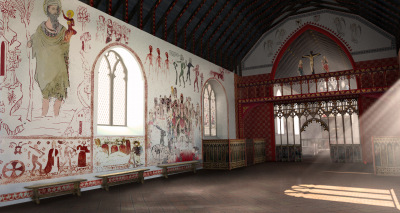
Among the paintings that have been uncovered is St Christopher carrying the Christ child across the river, and the three skeletons looking back on their lives. Some paintings were to encourage, some were intended to frighten!
A beautiful tomb, a strong chest and a door that once led to the rood loft are among many other things you can see.
The Lychgate and the Road that Moved
Today we hope all around you is peaceful. But it wasn't always the case. Outside the church you can see a lychgate, which was once the entrance from the road. The village was far from peaceful when the Pastons, as Lords of the manor, decided to move the road to where it is today!
From the churchyard path, there is a gate and another path. Walking along the path you'll see today's Paston Hall on your left. It was on this site that Judge William Paston – you may already have met him on your phone – built his great house. All sorts of investigations have been carried out to understand what that house once looked like – things like studying old pictures and digging holes across the lawns. Here's what a summer's day about 1600 might have looked like.
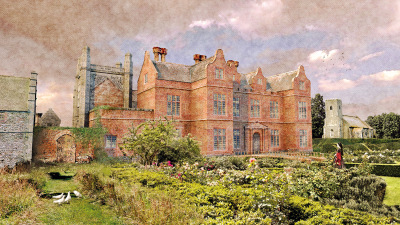
When you see today's hall, you can click on another option on your phone to see a computer model of the house. A whole 3D world will open up, enabling you to see Paston all those years ago. Today's hall is in private ownership, so you can't go there yourself, but you can see it in our virtual world. Imagine the hustle and bustle of a working hall and farm, with the Pastons living and enjoying their life on the Norfolk coast, looking after the lands in their manor – all travel being by foot or on horseback – and the comings and goings of their bailiffs and all the other farm workers.
The Great Barn
Turning round, you'll see the vast barn built by Sir William Paston (1528-1610). You can see the date it was completed by going up to the barn door. You can't go in; it's now a sheltered home for a colony of barbastelle bats, but we'll give you a look inside.
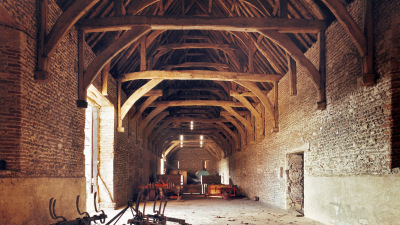
The great roof, with its mighty rafters, kept the rain from the farm goods that were stored there. Much of the storage was for barley or oats, often to be taken to Norwich or by ship to London. When we read the Paston Letters, the price of grain is often mentioned! Other summer foods – the vegetables from the gardens and the many fields around – were stored for winter.
Enjoy exploring!

